The great horse manure crisis: when the domain dissolves.
The most dangerous position in any field is not ignorance. It is being the expert optimising a system that is about to become irrelevant. The story of 1894 is a test you can run on your own domain -- today.
You have probably heard the story. In 1894, a writer in The Times of London warned that within fifty years every street in the city would be buried under nine feet of manure. In 1898, the first international urban planning conference convened in New York, supposedly collapsed after three days because nobody could find a solution, and went home. Then the automobile arrived, and the problem vanished.
There is one important detail the story usually leaves out: the nine-feet quote is almost certainly apocryphal. The Times refuted the attribution in 2018. The phrase traces to a 2004 article by Stephen Davies at the Foundation for Economic Education, not to any 1894 newspaper. No historian has located the original. The 1898 conference is more robustly attested -- multiple sources describe delegates going home early -- but the dramatic framing of total failure may also be retrospective myth-making.
Here is the thing: the myth-about-the-myth does not weaken the lesson. It sharpens it. Because the real story -- verified figures, documented crisis, genuine expert failure -- is more instructive than the legend. And the question at the end of it is one you should be asking about your own domain right now.
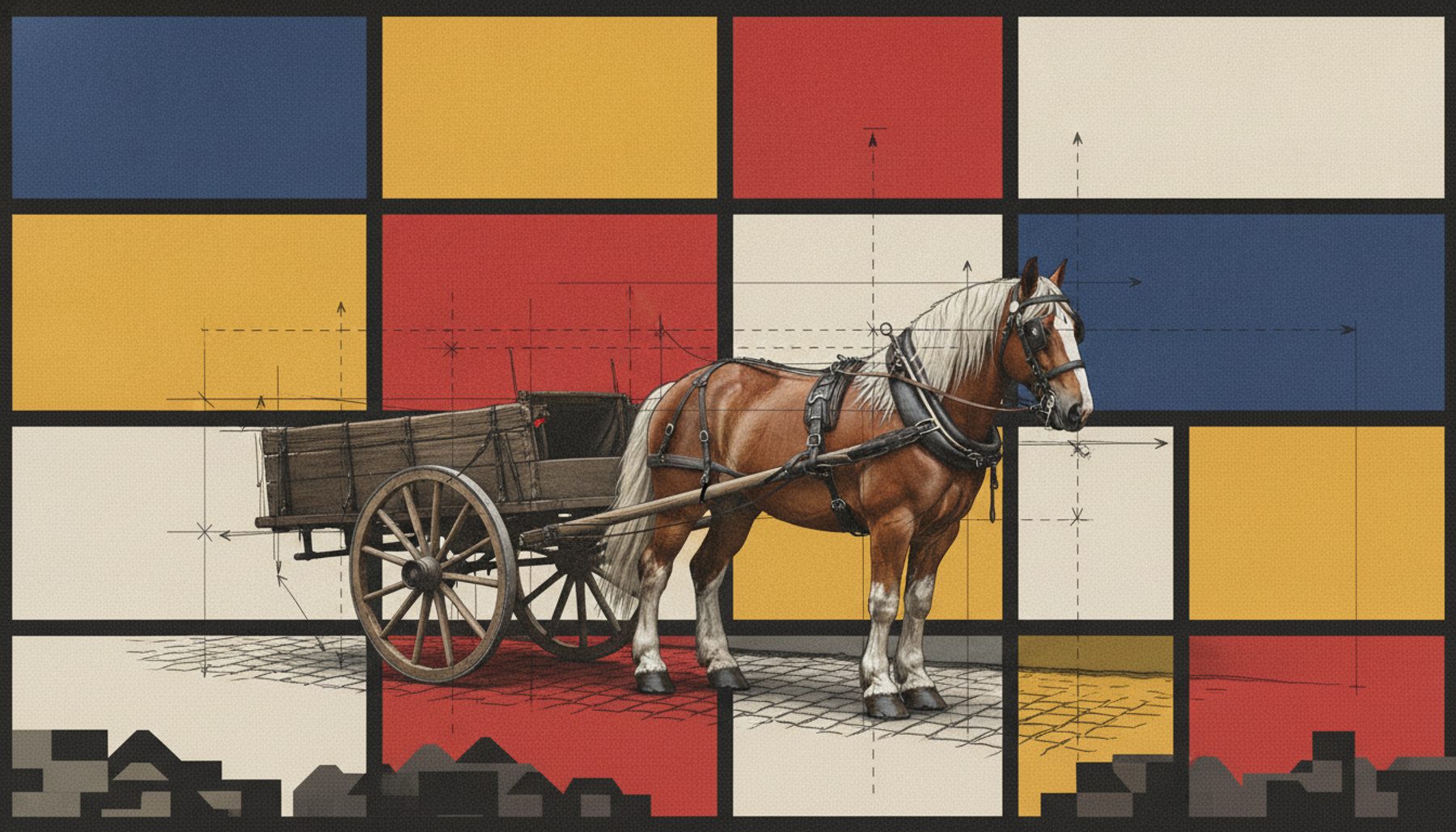
The crisis was real. The extrapolation was correct. The assumption was wrong.
Strip away the legend and the documented situation is striking enough. By 1900, London had more than 50,000 working horses -- 11,000 hansom cabs, several thousand horse-drawn buses each requiring twelve horses per day, plus the carts and drays serving what was then the largest city in the world. Each horse produced between 15 and 35 pounds of manure per day. London streets received an estimated 1,000 tons of manure daily. The manure bred flies, spread typhoid, and fouled water supplies.
New York's situation was, if anything, worse. By 1900, the city had roughly 100,000 horses producing 2.5 million pounds of manure per day (the figure comes from Burrows and Wallace's Gotham: A History of New York City to 1898). Once-vacant lots housed manure piles that stretched 40 to 60 feet into the sky. In 1880 alone, New York removed 15,000 horse carcasses from its streets.
The extrapolation really was obvious. More people meant more commerce meant more horses meant more manure. The city needed horses to function, needed more horses as it grew, and each new horse added to the problem it was supposed to solve. By the 1890s, horse manure -- once sold to farmers as fertiliser -- had become a disposal liability. Horse owners had to pay to get rid of it.
The 1898 conference, organised by New York's drainage engineer George E. Waring Jr., brought together city planners from across the world to address the manure problem. Multiple sources describe delegates going home after three days rather than the planned ten, unable to agree on a solution. The Wikipedia article on the crisis notes that the dramatic framing may be contested, but the documented fact of the conference -- and its lack of resolution -- is not.
The automobile did not solve the manure problem. It dissolved the domain that produced it.
The S-curve nobody at the conference could see.
While the delegates were in New York working on manure management, the automobile was climbing its S-curve in a different part of the conversation entirely. It was not a transportation solution in 1898. It was a wealthy person's curiosity. But the cost curve was bending. In 1900, 4,192 cars were sold in the United States. By 1912, that number had risen to 356,000. In 1912, traffic counts in New York City showed more cars than horses for the first time. The equine domain -- 100,000 horses and everything built to support them -- did not get better manure management. It became irrelevant.
This is what domain dissolution looks like from inside the old domain: nothing. No warning bell. No announcement. The best experts in the world meet to solve the crisis and fail not because they are unintelligent, but because they are optimising the wrong level. The crisis they are solving is a symptom of an assumption -- that horses are the necessary basis of urban transportation -- and that assumption is about to become historically false.
The problem does not get harder and then get solved. It vanishes. The people who positioned for the new domain -- early automobile manufacturers, tyre companies, petroleum distributors, road engineers -- did not win by solving the manure crisis. They won by betting that the domain producing the crisis was replaceable.
How to know a domain is dissolving, not just getting harder.
Experts converge on optimising the existing system -- better manure removal, faster scooping, more efficient carts. Nobody is asking whether the system itself is about to become irrelevant. Peak expertise at the wrong level is a signal the domain is near its ceiling.
More city requires more horses requires more manure: each step follows. But the chain rests on a hidden assumption -- horses as the only motive power. When an assumption is buried that deep, even correct extrapolation leads to the wrong conclusion.
The automobile was not a transportation idea at the time. It was a mechanical novelty, a wealthy person's curiosity. Dissolution often arrives from outside the domain -- which is exactly why the experts in the room cannot see it.
Horse manure was once an economic good that farmers paid for. By the 1890s, horse owners had to pay to get rid of it. When the core input of a system flips from asset to liability, the domain is near the end of its S-curve.
When the best assembled minds work hard and go home empty-handed, it is rarely because they were not smart enough. It is because they were solving a constraint inside a domain that was already dissolving. No solution exists at that level.
Nobody solved the manure crisis. There was no breakthrough in manure management. The domain that produced the problem was replaced, and the problem went with it. Dissolution looks like a miracle from inside the old domain.
The film industry did not solve the digital problem. It dissolved.
The pattern is not ancient history. Consider Kodak. At its peak in the mid-1990s, Kodak commanded roughly 90% of U.S. film sales and 85% of camera sales, with a market cap above $28 billion. The company's entire competitive position -- film production, chemical processing, printing -- rested on one central assumption: that photographs required physical film.
Kodak's engineers knew digital photography was coming. The company had invented key digital sensor technology in 1975. But the business was structured around film -- and when the domain assumption began to dissolve, the expert response was to optimise the old system. The 1996 Advantix Preview camera was a digital camera that still used film, because Kodak was in the film business. It flopped. Between 2000 and 2006, global demand for color photographic film fell by 60%. Kodak filed for bankruptcy in 2012. The domain did not get harder. It dissolved.
The navigator's advantage here is not predicting which technology wins. It is asking the prior question: is the central assumption of my domain still intact, or is a new S-curve climbing in a different part of the conversation?
What is changing in your domain that is about to collapse -- and how do you take advantage of it?
This is the question every navigator must ask. Not once, in a strategy offsite. Regularly, as a discipline. The manure experts were not unintelligent. They were asking the wrong question at the wrong level. They were solving how to remove manure faster. The question worth asking was: what assumption does this domain rest on, and is that assumption about to become optional?
Push the trend in your own field to its absurd extreme. At the absurdity, the hidden assumption becomes visible. That is the thing to bet on or bet against.
This is what /mos:explore-trends is built for -- not trend reporting, but trend extrapolation until the structural assumption underneath breaks the surface.
The trend-to-absurd exercise, run on your own domain.
Running this on your own field is a Problems Worth Solving exercise built from 30+ years of teaching innovation in research-intensive organisations. The steps are simple. The discipline is not. Push the trend in your domain to its logical extreme. Name what breaks first. That break is where the hidden assumption lives. Then ask whether a new S-curve -- climbing somewhere outside your domain -- makes that assumption unnecessary.
The manure experts could have run this exercise in 1897. Extrapolate: more city, more horses, nine feet of manure. What breaks first? Probably urban livability -- disease, congestion, cost. What assumption underlies it? That horses are the only viable motive power. What is climbing the S-curve? A mechanical engine that runs on petroleum, not hay. Naming that question in 1897 would not have guaranteed you bet correctly. But it would have put you in the right room.
Copy this. Fill in your field. Paste it into MindrianOS.
I want to understand the timing in my domain, and I think I might be standing inside a collapsing structure without realising it.

My domain: [DESCRIBE YOUR FIELD IN ONE OR TWO LINES -- what you research, build, or operate, and what the central dependency or constraint is right now].

Here is what I notice. My field has a central assumption everybody builds on -- a resource, a platform, a regulatory regime, a technology, or a business model. For as long as anyone can remember, more demand meant more of that thing. The extrapolation seemed obvious. But lately I see signals that the thing underneath is starting to shift, or that a new technology is climbing an S-curve in a way that could make our central assumption irrelevant.

It reminds me of the horse-manure story. Experts in 1894 extrapolated the trend: more city, more horses, more manure. The extrapolation was correct. The assumption underneath it -- that cities would always run on horses -- was not. The automobile did not solve the manure problem. It dissolved the domain that produced it.

Help me think through this properly. First: is what I am seeing a solvable constraint (the domain gets harder but stays intact), or an emerging dissolution (a new S-curve is replacing the domain underneath my field)? Do not jump to a strategy. Then place it on the curve, show me what is actually shifting, and tell me where the real opening is -- not a better version of the old thing, but the move that bets on the new domain.
Six moves, trend first.
Each command is copyable. Every one is a real MindrianOS move, documented in the catalog. The notes track the running example: the horse manure crisis of 1894 and the automobile S-curve.
- 1Open a room and describe your domain
Larry does not start with solutions. He reads the domain structure first -- what the central dependency is and whether it is a constraint or a dissolution.
On the manure crisisThe manure experts were solving a constraint problem. The automobile investors were betting on a dissolution. The difference in starting assumption decided everything.
- 2Push the trend to its logical extreme
Take the trend your field is currently riding and extrapolate it until the absurdity appears. That is where the assumption underneath becomes visible.
On the manure crisisNine feet of manure is the extrapolation made legible. The absurdity reveals that the assumption -- horses as the only urban motive power -- was the real variable.
- 3Find what is climbing the S-curve underneath
Maps the macro forces at play -- technology, regulation, economics, culture -- and surfaces which one is on the steep part of its adoption curve.
On the manure crisisThe automobile was on a steep climb in 1898. Delegates at the urban planning conference could not see it. It was not in their domain.
- 4Place the new S-curve on the clock
Early signal, inflection point, or rapid diffusion. The clock position changes the move entirely. Too early is wasteful; at inflection is the window.
On the manure crisisBy 1912, traffic counts in New York showed more cars than horses. The window to bet on dissolution was roughly 1900 to 1908.
- 5Borrow a collapse from another field
The pattern of domain dissolution repeats across industries. Same structure, different material. Cross-domain analogy is where the real timing model comes from.
On the manure crisisFilm photography, physical music retail, analogue telephony: each dissolved when a new S-curve made the central assumption obsolete. The shape is always the same.
- 6Turn the signals into a navigator's position
Climbs from scattered signals to a timing thesis you can defend, act on, and keep watching. You leave with a position, not a prediction.
On the manure crisisThe position is not 'cars will win.' It is 'the domain dissolves when cars reach X% of urban traffic, and here is what that unlocks.'
- The "nine feet" quote -- flagged apocryphal. The phrase originates from a 2004 article by Stephen Davies at the Foundation for Economic Education, not from any verified 1894 Times of London article. The Times formally refuted the attribution in 2018. Source: Wikipedia, Great horse manure crisis of 1894.
- The 1898 conference -- partially verified. The conference was organised by New York sanitation commissioner George E. Waring Jr. Multiple sources including Atlas Obscura describe delegates leaving after three days without a solution. The dramatic framing may be embellished in retrospect; Wikipedia notes the "broke up early" claim is not independently confirmed.
- London horses and manure, 1900 -- verified. 50,000+ working horses, 11,000 hansom cabs. Source: Stephen Davies, FEE (2004), citing period records.
- New York 100,000 horses, 2.5 million pounds/day -- verified. Source: Edwin G. Burrows and Mike Wallace, Gotham: A History of New York City to 1898 (Oxford University Press, 1999), as cited in Davies (2004).
- Automobile adoption -- verified. 4,192 U.S. car sales in 1900; 356,000 in 1912. Cars outnumbered horses in New York City traffic in 1912. Source: The Breakthrough Institute, "Revolutionary Engines".
- Kodak film domain dissolution -- verified. Global color film demand fell 60% between 2000 and 2006. Kodak filed for bankruptcy in January 2012. Source: Quartr, "The Dilemma That Brought Down Kodak"; Forbes, "How Kodak Failed" (Chunka Mui, 2012).
- MindrianOS Brain. The explore-trends framework (push trends to extremes, expose hidden assumptions), macro-trends analysis, S-curve timing, and domain dissolution pattern. Drawn from the teaching corpus (30+ years of PWS instruction).
Ready when you are. Install MindrianOS. Start asking the question.