The bag was the bottleneck.
Every system is held back by one lagging part, not by its strongest one. For decades the vacuum industry built a bigger motor and never touched the part that was choking it. Here is how James Dyson found the lagging part, and a dare to find yours.
You have done it. A product that stalls, a process that drags, a team that misses. You reach for the obvious lever and push harder on it. More compute. More budget. More horsepower. It feels like progress, and the numbers on the spec sheet agree with you.
Here is why it should bother you. A system does not advance at the speed of its best component. It advances at the speed of its worst one. Pour effort into a part that was never the limiter and almost none of it reaches the output. The spec sheet climbs while the lived experience stays flat. The skill that separates teams that compound from teams that thrash is not working harder on the obvious part. It is finding the part that is quietly holding everything else back, and that part has a name.
When suction stalls, everyone reaches for the motor.
For most of the twentieth century the vacuum cleaner improved on one axis: the motor. Every season the watts went up, the box bragged about peak suction, and the engineers felt the satisfaction of a number going in the right direction.
And in the home, nothing much changed. The first pass across the carpet was strong. The second was weaker. By the time the bag was a third full, the powerful new motor was straining against a wall of clogged fabric and the floor was barely cleaner than before. Nobody in the room asked the only question that mattered: if the motor keeps getting stronger and the cleaning does not, what is actually capping this system?
That reflex, straight to the obvious lever, is the whole subject of this piece. The motor was never the limiter. The part nobody would look at was.
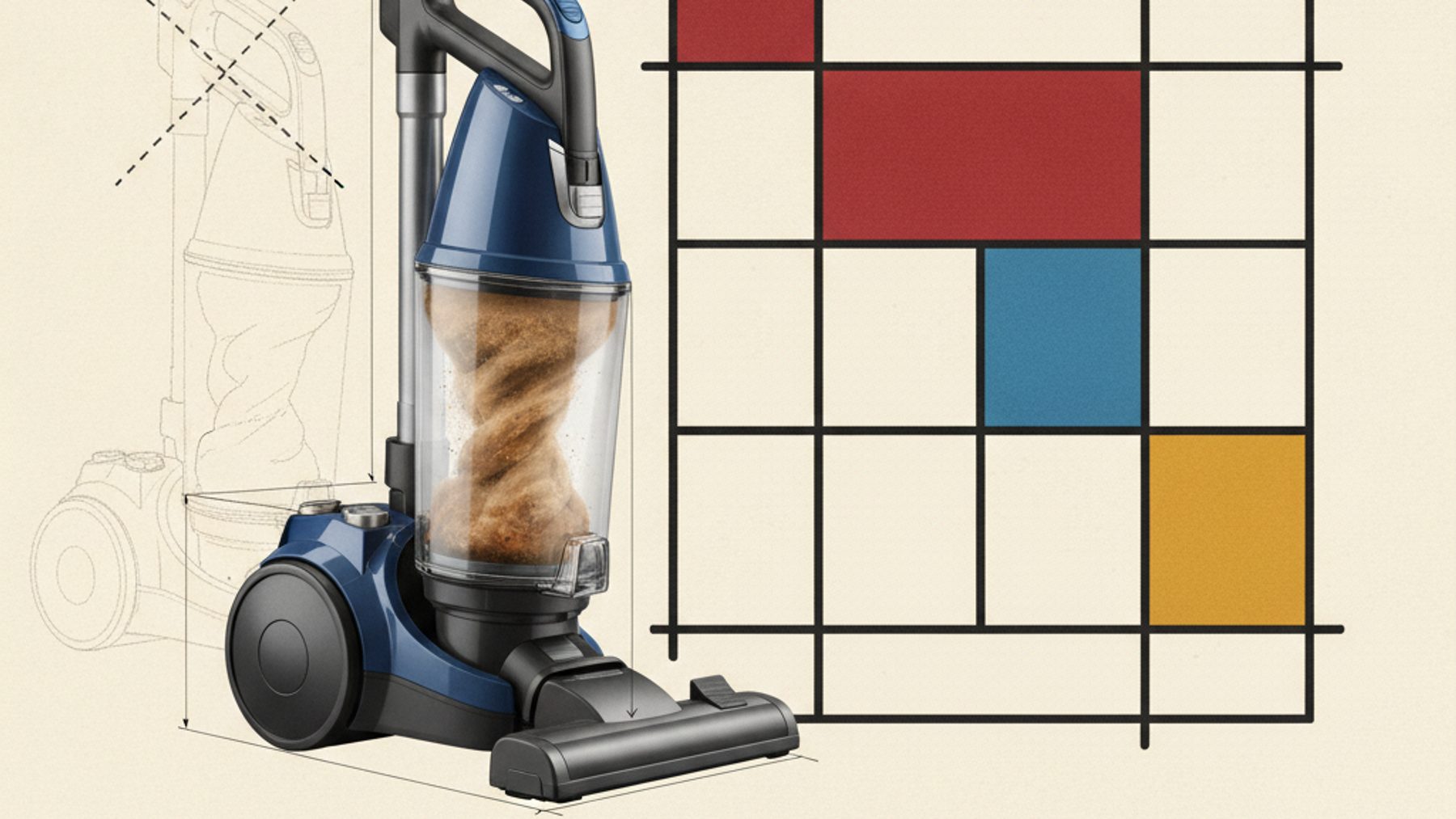
Follow the airflow, and the lagging part appears.
A vacuum is a small system: a motor pulls air, the air carries dust, and something has to separate the dust from the air before the air leaves the machine. For a century that something was the dust bag. Air passed through the bag’s woven pores, the dust stayed behind, and the bag did double duty as both filter and bin.
That double duty is the trap. The instant the bag begins to fill, dust packs into the pores and the bag becomes its own blockage. Airflow drops, and suction drops with it, long before the bag is anywhere near full. So the system had a hard ceiling that had nothing to do with the motor. You could double the watts and the bag would still throttle the airflow back down. The bag was the reverse salient: the one component that had fallen behind and was holding the whole machine in place. And because the bag was a consumable the industry sold by the box, it was the one part nobody had any incentive to question.
Decades of motor upgrades were effort poured into a part that was already ahead of the limiter. The work was real. It just never reached the floor.
He did not build a better bag. He asked why the bag existed at all.
Name the salient, then delete the function.
The idea is older than the vacuum and has nothing to do with appliances. The historian Thomas Hughes studied how large technological systems grow and noticed they advance like a battle front: unevenly, with some parts surging ahead and others lagging. He called the lagging parts reverse salients, and he found that progress comes from spotting them, renaming each one as a critical problem, and concentrating effort there rather than on the parts already winning. Once you name the bag as the critical problem, the choice gets sharp: improve the component, or remove the function it performs entirely.
Dyson chose to remove it. The function he needed was separating dust from moving air, and that function already existed, fully solved, in a completely different field. Industrial cyclone towers had been spinning sawdust and grain particles out of airflow for years. He borrowed the cyclone, dropped it in where the bag had been, and the bag simply ceased to exist. Constant suction, because there was no longer a clogging filter in the airflow. It famously took more than five thousand prototypes to make the small-scale cyclone work, but the conceptual leap was the cheap part: the bag is the problem, so delete the bag.
And notice what happened next. With the bag gone, the front advanced, and a new reverse salient appeared further along: fine-particle filtration, then noise, then bin emptying. That is the rhythm. Solve one lagging component and the limiter moves. The work is never finished, but it is always findable.
How to find the part that is holding you back.
As any system grows, its parts improve at different rates. Some race ahead, some fall behind. The mistake is to assume your performance is set by your best component. It is set by the one that fell behind, and that one is usually the part you stopped looking at.
The phrase comes from a battle line. A salient is a section that bulges forward. A reverse salient is a section that has dropped behind the advancing front and holds the whole line in place. In the vacuum it was the bag. Find yours before you spend a single dollar improving anything else.
You add power, money, people, and the system barely moves. That widening gap between what you pour in and what comes out is the signature of a lagging component quietly absorbing all of it. The motor got stronger every year. The clean floor did not.
Once the salient is named it becomes a problem you can actually solve. Now you have a choice: improve the component, or delete the function it performs and import that function from a field that already solved it. Dyson did the second. He did not want a better bag. He wanted the bag gone.
This one is not a metaphor. It is an engine.
Reverse Salient is not a story MindrianOS tells. It is a first-class move it runs. /mos:find-bottlenecks maps your system and surfaces the lagging component as a decision gate, so you argue about the right part before you spend on the wrong one. The same instinct that took the vacuum industry a century to reach is the first question the tool asks.
For a worked case of the framework colliding with others in a live project, see when frameworks intersect: reverse salient in the wild. This piece is the concept; that one is the field report. The fix was never a stronger motor. It was the question the whole category skipped: which part is actually holding this back, before I push harder on the obvious one?
You think you have a power problem. You have a part you stopped looking at.
So test it. Copy the system below, drop it into MindrianOS, and find the reverse salient before you touch the obvious lever. Larry will not hand you a bigger motor. He finds the lagging component first, then picks the move to match. Bet you cannot name the limiter before he does.
Copy the system. Mindrian kicks in.
I have a system that keeps hitting a performance ceiling, and I think I am optimizing the wrong part.

The object: a household vacuum cleaner. For years the industry made the motor more powerful every season. On paper the suction kept climbing. In the home it did not. Real cleaning performance flattened out, and customers stopped feeling a difference between models.

Here is the part everyone treated as fixed: the dust bag. Air has to pass through the bag's pores to leave the dust behind. The moment the bag starts filling, those pores clog, airflow collapses, and suction falls, no matter how strong the motor is. The bag was sold as a consumable, so nobody questioned it. They just bolted on a bigger motor to push against a bag that was choking the airflow.

Help me think this through properly. Do not jump to a fix. First find the reverse salient: which single component is the lagging part that caps the whole system's advance, and how do you prove it is the limiter rather than the motor? Then tell me the move. Do I improve that component, or delete the function it performs and import that function from another domain that already solved it?
Five moves, lagging part first.
Each command is copyable. Every one is a real MindrianOS move, documented in the catalog.
- 1Open a room and paste the system
Larry reads the whole thing and refuses to hand you a bigger motor. First he looks for the part that is holding everything else back.
On the bagless vacuumHe names it out loud: the bag, not the motor, is the part capping this system.
- 2Classify the ceiling
Is this a power problem or a structural one? Getting the type right is the single highest-leverage call you make all project.
On the bagless vacuumThe bag fails every test for a power problem. No amount of watts un-clogs a filling filter.
- 3Find the reverse salient
The command maps the system and surfaces the one lagging component that is dragging the whole front back. This is the move the whole piece is about.
On the bagless vacuumPlot suction against fill level and the bag lights up. Every other component was already ahead of it.
- 4Map the domain and the prior art
Pulls in where this same function has already been solved, as typed graph evidence rather than a hunch.
On the bagless vacuumCyclonic separation was already pulling particles out of air in sawmills and grain mills. The answer was running in another industry.
- 5Find the opening nobody is taking
Maps the terms of competition and surfaces the unaddressed move sitting in the gap.
On the bagless vacuumThe opening was never a stronger motor. It was deleting the bag the entire category had assumed was permanent.
- MindrianOS Brain. The reverse-salient framing (systems advance unevenly, the lagging component caps the whole, name it as a critical problem and concentrate effort there) is drawn from the teaching corpus.
- Thomas P. Hughes (1983). The origin of the reverse salient concept, from Networks of Power. Overview: Reverse salient.
- The vacuum. Background on cyclonic separation and the bagless design: Vacuum cleaner.
Ready when you are. Install MindrianOS. Start thinking with Larry.