The automobile was the first green technology.
By 1900 the modern city was drowning in horse manure, and the car arrived as the clean machine that saved it. Then it choked the same city it rescued. Every change destroys and creates, and the money is never in the first ring of consequences. Here is the wheel that traces the rings, and a dare at the end.
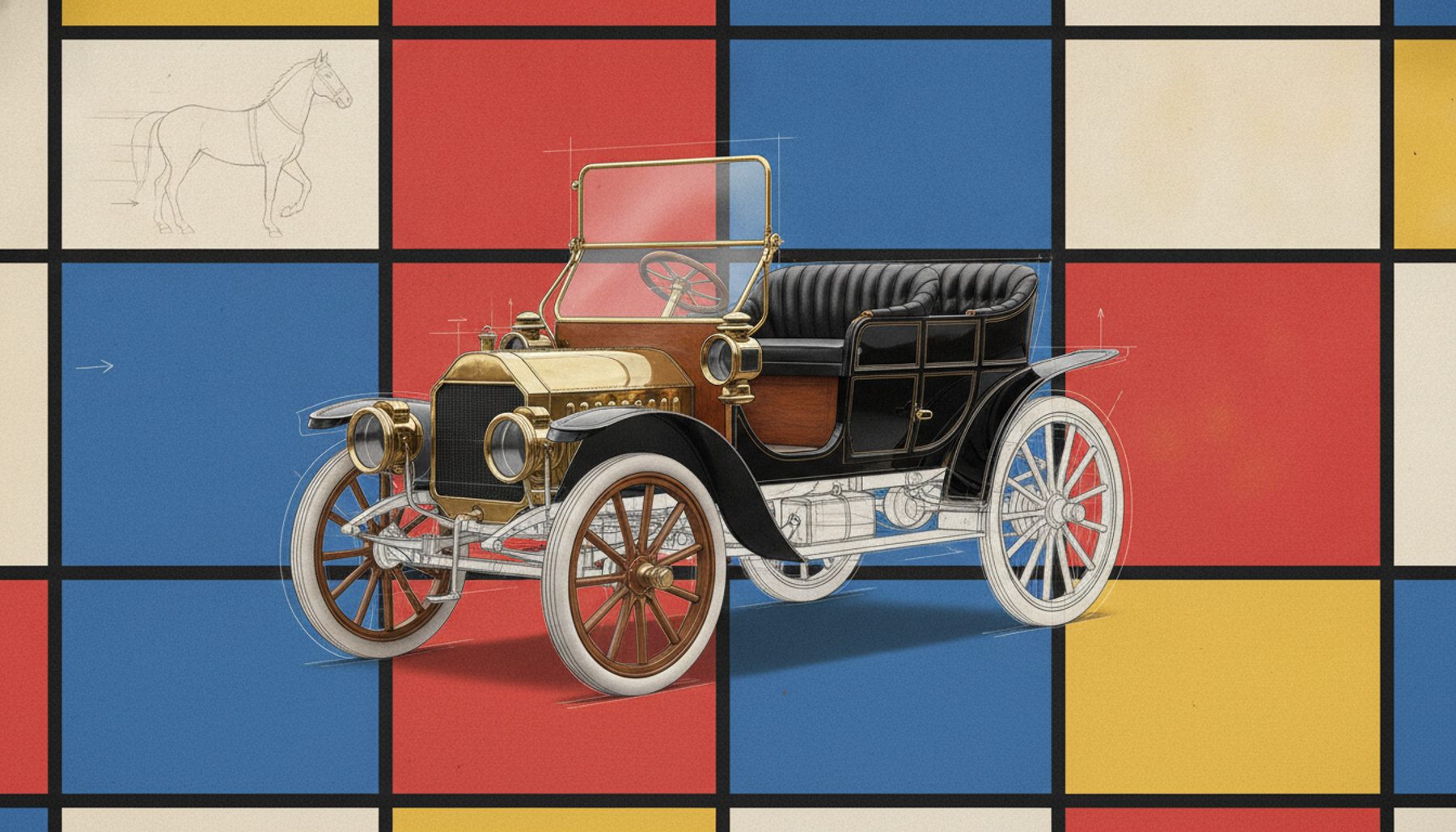
Picture the wealthiest street in the world in 1894, and now add the part the postcards left out: a working city ran on horses, six figures of them, and a single horse drops more than twenty pounds of manure a day. Multiply, and a great city was shoveling millions of pounds off its streets every single day, plus thousands of carcasses a year, plus the flies and the typhoid that came with all of it.
Serious people did the arithmetic and projected the streets buried within decades. And the era's best minds attacked the problem the only way settled minds can: with horse-era answers. More sweepers. More carts. Stricter rules. The story goes that an early international planning conference broke up early because nobody had a solution, and whether or not that detail is legend, the underlying fact is not: the smartest people in the room were optimizing the manure system, because not one of them treated the horse as a variable. Then the variable changed by itself.
Do not judge the change. Interrogate it.
When the automobile arrived in the late 1880s, the public argument split instantly into the two least useful camps: progress versus menace, good versus bad. That argument is a reflex, and it is the wrong one. Thirty years of teaching innovation distill to one instinct given to every cohort: this is not a philosophy class. Do not ask whether the change is good or bad. Ask what it destroys and what door it opens.
Run that lens on the car and the verdict flips a century of intuition: by the only standard that mattered in 1900, the automobile was the clean technology. No manure. No carcasses. No flies. The machine we now spend trillions trying to replace was, on arrival, the environmental rescue of the modern city. The point is not irony. The point is that “green” is a position on a wheel that keeps turning, and the wheel can be drawn.
One event, two ledgers. The discipline is filling in both columns before deciding what you think.
Put the change in the center. Ring outward.
The futures wheel is the simplest serious tool in foresight: the change goes in the hub, the direct consequences make the first ring, the consequences of those consequences make the second, and the third ring is where the world quietly gets rebuilt. The automobile is the canonical lap around the wheel: no horses is the first ring. Gas stations, mechanics, traffic lights is the second. Factories, the modern middle manager, the suburb, and eventually the smog is the third.
Nobody who said “horseless carriage” in 1895 was picturing the supermarket, the motel, or the morning commute. That is not a failure of intelligence. Human intuition reliably stops one ring out, and almost all of the century's wealth was created two and three rings out. The wheel exists to carry you past the radius where your intuition quits.
And the wheel keeps turning. The third ring of the last rescue becomes the crisis of the next era: the clean machine of 1900 is the emissions problem of 2000, which summoned its own generation of saviors, each accumulating consequences of their own. The loop has no exit. That is not pessimism. It is a permanent source of problems worth solving, on a schedule, for whoever traces the rings first.
Do not ask whether the change is good or bad. Ask what it destroys, and what door it opens.
The savior becomes the problem. Every time.
Crisis summons a savior. The savior wins, scales, and compounds, and its outer rings pile up like manure on the cobblestones, until the savior is the crisis and the cycle calls for the next one. Horse to car to whatever absorbs the car's externalities next. If you can place your own industry on this loop, you know what is coming before the consensus does, because the loop only ever moves one way.
Six rules for reading any change.
Not "disrupts an industry." Something nameable: the stable, the hay trade, the street sweeper's job, the blacksmith's anvil. If you cannot name what your change destroys, you have not understood it yet, and neither has the market.
The same stroke that emptied the stables created the gas station, the mechanic, the driving school, and the parking lot. Destruction and creation are one event seen from two sides. The discipline is to always ask both questions, in that order.
The obvious consequences are priced immediately: cleaner streets, faster travel. First-ring bets are crowded bets. The wheel exists precisely because human intuition stops one ring out, and the compounding starts two rings out.
Gas stations, motels, suburbs, supermarkets, the commuter economy: none of these were visible in the word "horseless." Second and third order consequences built more wealth than the car itself. Trace the rings before someone else does.
The clean technology of 1900 is the emissions problem of 2000. Whatever rescues your industry today is accumulating its own manure pile right now. Asking "what does the savior destroy?" early is how you find the next rescue before it is urgent.
Everyone solving the manure crisis assumed the horse. Everyone optimizing the helicopter assumed the unwatched sky. Every wheel you ring should include one spoke that deletes the thing your field treats as permanent, just to see what the city looks like without it.
Intuition stops one ring out. The method does not.
Most teams meet a macro change the way 1894 met the manure: they optimize inside the old constant, argue good-versus-bad, and price only the first ring. The alternative is mechanical, which is exactly why it works under pressure: hub, rings, two ledgers per ring, and an honest spoke for the thing you assume is permanent.
That sequence is what MindrianOS runs. The framework catalog carries the macro scan, the trend-to-the-absurd stretch, and scenario branching as commands, and Larry chains them in order instead of handing you a vibes-based forecast. The same wheel that explains the gas station will ring the consequences of the change happening in your field right now. Which is the point of the dare below.
A change is remaking your field right now. Have you ringed it?
Copy the story below, swap in the change you are living through, and drop it into MindrianOS. Larry will not hand you a verdict. He rings the wheel first, both ledgers, with sources, and only then talks opportunity. Bet the third ring holds something you have not priced.
Copy the story. Mindrian kicks in.
I want to trace the consequences of a change in my field before I bet on it. First reason through this story with me, then run the same wheel on my domain.

The story: by 1900 the modern city was drowning in its own transport. A big city ran on six figures of working horses, and each one dropped over twenty pounds of manure a day onto the streets - millions of pounds every single day, plus the carcasses, the flies, and the disease that came with them. Serious people projected that within decades the streets would be buried. Every proposed fix was a horse-era fix: more sweepers, more carts, more regulation. Nobody in the manure business asked whether the horse was a constant.

Then the automobile arrived, and by the standards of its day it was the clean technology. No manure, no carcasses, no flies. It saved the city. And then, ring by ring, it remade everything: no horses meant gas stations, mechanics, and traffic lights; mass production meant factories and a new kind of middle manager; roads meant suburbs; suburbs meant commutes; commutes meant smog, and a century later the savior had become the problem the next green technology is trying to solve.

The lesson is the lens: every change destroys something and creates something, and the money is almost never in the first ring of consequences. It is two or three rings out, where nobody is looking yet.

Now my field: [describe a change happening in your domain in one or two sentences].

Work it properly. Put the change in the center of a futures wheel. Ring out the first, second, and third order consequences. For each ring, name explicitly what gets destroyed and what gets created. Do not judge the change as good or bad, and do not pitch a product until the wheel is complete. Every factual claim needs a real, linkable source, or mark it explicitly as a hypothesis.
Six moves, the wheel before the bet.
Each command is copyable. Every one is a real MindrianOS move, documented in the catalog.
- 1Open a room and paste the story
Larry reads the whole thing and asks for the change you actually want to trace. The horse city becomes the worked example your domain is measured against.
On the horse cityThe wheel is the lens. Your change goes in the hub.
- 2Ring the wheel on your change
The macro scan: political, economic, social, technological. First, second, third order consequences, each ring built from the one before it.
On the horse cityThe automobile's first ring was clean streets. The third ring was the suburb.
- 3Push the trend to its absurd end
Take the change and stretch it to the edge. The problems that appear at the extreme are the opportunities nobody has priced yet.
On the horse cityStreets buried in manure was the absurd end. It made the car thinkable.
- 4Branch the futures you cannot predict
A 2x2 of the two biggest uncertainties. Four worlds, each with its own winners, so your bet survives more than one of them.
On the horse cityNobody in 1900 planned for smog. One scenario out of four would have caught it.
- 5Find who else rode this wheel
Cross-domain patterns: which other industries lived the same destroy-and-create cycle, and what did the winners see early.
On the horse cityThe savior-becomes-the-problem loop runs in every era. Find its current lap.
- 6Climb to a defensible position
From scattered claims to cited evidence to one to three well-defined problem statements you can bank and act on.
On the horse cityYou leave with a consequence map and a problem portfolio, not a hot take.
- MindrianOS Brain. The destroy-and-create lens, futures-wheel ringing, the savior-becomes-the-problem loop, and the first-ring-fools-you doctrine. The classroom framing is drawn from the teaching corpus.
- The manure crisis. Background and the contested conference legend: Great horse manure crisis of 1894. The projection figures vary by source; the daily tonnage arithmetic does not.
- The futures wheel.Jerome Glenn's structured consequence mapping, 1971. Overview: Futures wheel.
- The automobile. The late-1880s arrival: Benz Patent-Motorwagen.
Ready when you are. Install MindrianOS. Start thinking with Larry.