Maybe a tank needs to be an ambulance.
For a hundred years, rescue meant moving the wounded to the care, faster every decade. Then cheap drones broke the one assumption the whole design stood on. Here is how a dominant design dies in public, and how to spot the same break in your own field while the window is still open.
Every field has one architecture so settled that nobody calls it a choice anymore. The QWERTY keyboard. The shipping container. The USB plug. In battlefield medicine it was a doctrine with a beautiful name, the golden hour: reach surgical care within sixty minutes and most of the badly wounded live.
The lesson of this piece is not about medicine. It is about what a settled architecture quietly rests on, what happens the day that foundation gives way, and why that day is the single best moment an entrepreneur will ever get. The scholars call the architecture a dominant design, and the chaos after it breaks an era of ferment. Incumbents win the calm. Entrants win the ferment. Which means the most valuable skill in innovation is not building. It is noticing, early, that the calm is ending.
A line dropped mid-lecture, and the room went quiet.
A cohort of founders, an innovation lecture, the topic is how settled designs break. A veteran innovation instructor, who has taught the subject for more than thirty years, is walking through what happens to combat rescue when the sky is permanently watched, and drops one line on the room: “maybe a tank needs to be an ambulance.”
Watch what the sentence does. It does not propose a vehicle. It violates a category. Tanks fight, ambulances rescue, and the two have been separate words for a century because the dominant design kept them separate: the ambulance never needed armor, because the ambulance was never supposed to be a target. The sentence only becomes thinkable after the old design is already dead, and most of the room had not yet noticed it was.
The chain that defined rescue for a century, and the link that snapped. Not the vehicle. The assumption underneath the vehicle.
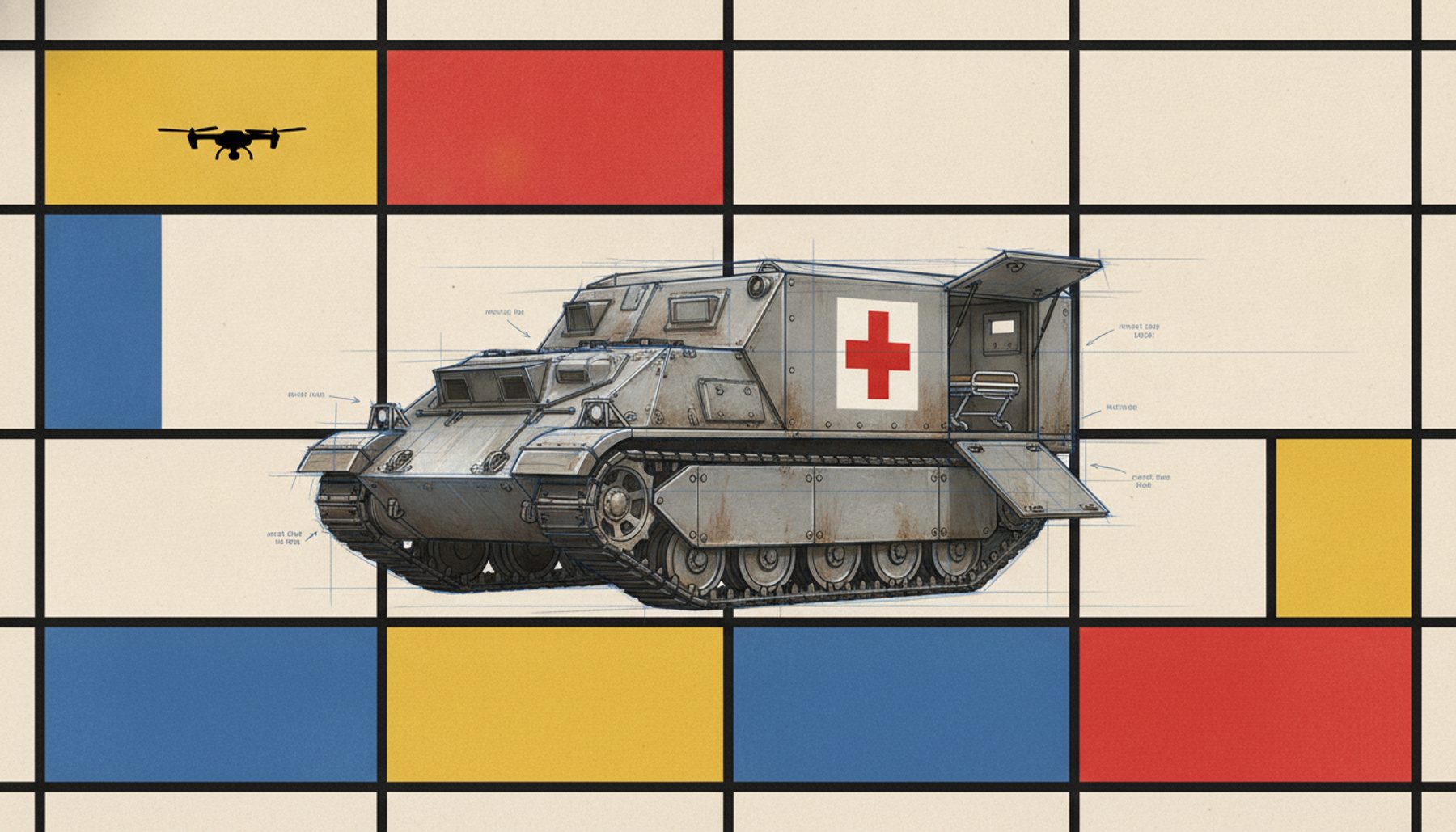
A century of getting faster, and one silent assumption.
The architecture of rescue improved relentlessly: stretcher bearers, then motor ambulances, then the evacuation helicopter, each generation collapsing the distance between wound and surgeon. By the time the golden hour became doctrine, the design was so dominant that an entire logistics chain, training pipeline, and vehicle industry was built around one verb: evacuate.
Every link in that chain assumed the same thing: the carrier moves, and the sky does not watch. Cheap drones deleted that assumption. Not with a better ambulance, not with a counter-doctrine, but with permanent eyes. In recent conflicts the pattern has been documented openly: anything that moves is seen, anything seen is hit, and casualty evacuation windows stretch from the golden hour to many hours, sometimes days. The fastest helicopter in the world does not fix that, because speed was never the failing variable. The dominant design did not lose a performance race. The world withdrew its premise.
This is the cycle Anderson and Tushman documented across a century of industrial data: a discontinuity lands, an era of ferment opens, competing architectures fight, one wins, and an era of incremental change follows until the next discontinuity. Combat medicine is in the ferment right now: forward care that moves the surgeon to the casualty, armored evacuation that accepts being seen, autonomous vehicles that take the human out of the trip. Nobody knows which wins. That is exactly what the open window looks like.
Incumbents win the incremental era. Entrants win the ferment.
The era decides who wins. Not the idea.
During the incremental era, the dominant design is the moat: scale, supply chains, and certification all favor whoever owns the standard. A better idea loses to a settled architecture almost every time. But inside the ferment the moat drains. The incumbent's assets are tuned to the dead assumption, and tuning is expensive to undo. The entrant carries nothing. The whole game, then, is knowing which era your field is actually in, before the consensus does. That is a classification question, and classification questions can be worked methodically instead of vibed.
How to know a dominant design is breaking.
A dominant design never announces what it rests on. The golden hour never said "this requires unwatched skies" out loud. By the time the assumption is visible, it is usually already dead. Ask what your field's standard silently requires, then check whether it is still true.
When a design starts failing, the first response is never replacement. It is patches: more armor, lower flight profiles, new procedures stacked on old doctrine. A rising count of compensations around a stable core is the sound of a design being kept alive past its era.
Faster helicopters do not help when the problem is being seen. When improving the spec no longer improves the outcome, the S-curve has not just flattened, the axis itself has changed. That is a discontinuity, not a plateau.
People keep saying "evacuation window" when there is no window. Language outlives the reality it described. When practitioners use the standard terms with visible discomfort, the map no longer matches the territory.
The edge cases abandon the standard before the center admits anything is wrong. Field medics improvising forward care ahead of doctrine are the same signal as power users abandoning a platform: watch the edges, not the announcements.
Forward care, armored evacuation, autonomous vehicles: when several incompatible answers compete and none has won, you are inside the era of ferment. That window is when entrants beat incumbents, and it closes the day a new design becomes dominant.
Ferment is detectable. So detect it.
Most teams meet a breaking design the way the lecture room did: with a category they refuse to violate. They keep optimizing the helicopter while the sky fills with eyes, because the dominant design is not just in the market, it is in their heads. The fix is not creativity on demand. It is a sequence: name the design, name its era, name the hidden assumption, and check the assumption against the world. Every step is a real move with a real method behind it.
That sequence is what MindrianOS runs. The framework catalog carries the Utterback-Abernathy scan, the S-curve clock, and the reverse-salient hunt as commands, and Larry chains them in the right order instead of handing you a brainstorm. The same lens that explains the armored ambulance will name the breaking design in logistics, in diagnostics, in software distribution, in whatever field you bring it. Which is the point of the dare below.
Your field has a dominant design. Do you know which era it is in?
Copy the story below, swap in your domain, and drop it into MindrianOS. Larry will not pitch you a product. He names the design, the era, and the hidden assumption first, with sources, and only then goes hunting for the break. Bet the assumption he finds is one you have never said out loud.
Copy the story. Mindrian kicks in.
I want to find where a dominant design is breaking in my field. First reason through this story with me, then turn the same lens on my domain.

The story: for a century, battlefield medicine had one dominant design - move the wounded to the care. Stretcher bearers, then motor ambulances, then evacuation helicopters, each generation faster than the last, until the doctrine had a name: the golden hour. Reach surgical care within sixty minutes and most of the badly wounded survive.

The whole architecture rested on one hidden assumption: the thing carrying the wounded can move without being seen.

Cheap drones broke that assumption. The sky is now permanently watched. Anything that moves is seen, and anything seen is hit. Helicopters cannot land. Ambulances cannot drive. The wounded wait not one hour but many, sometimes days. The dominant design did not lose to a better ambulance. The assumption underneath it died.

So the era of ferment is open, and the candidate architectures are fighting it out: care moves forward to the casualty instead of the casualty moving back. Vehicles get armored until maybe a tank needs to be an ambulance. Evacuation goes autonomous so nothing human has to make the trip.

Now my field: [describe your domain in one or two sentences].

Work it properly. First name the dominant design in my field and the era it is in - ferment or incremental. Then name the hidden assumption the design rests on. Then look for where that assumption is weakening, the way unwatched skies quietly disappeared. Do not pitch solutions until the assumption map is done. Every factual claim needs a real, linkable source, or mark it explicitly as a hypothesis.
Six moves, assumptions before answers.
Each command is copyable. Every one is a real MindrianOS move, documented in the catalog.
- 1Open a room and paste the story
Larry reads the whole thing and asks for your field before he touches a single fix. The ambulance becomes the worked example your domain is measured against.
On the broken ambulanceThe story is the lens. Your domain is the lab.
- 2Name the dominant design and its era
The Utterback-Abernathy scan: what architecture won, when, and whether your field is in the incremental era or already in ferment.
On the broken ambulanceGolden-hour evacuation was the dominant design. The discontinuity has already landed.
- 3Put the architecture on the S-curve clock
Every technology tops out, from physics or from the market. The question is where on the curve your field's standard is sitting right now.
On the broken ambulanceThe helicopter's curve never flattened. Its runway disappeared instead.
- 4Find the lagging subsystem
The reverse salient: the one component holding the whole expanding system back. That is where the pressure, and the opportunity, concentrates.
On the broken ambulanceSurvivable movement is the reverse salient. Every other fix waits on it.
- 5Steal from a field that survived its own ferment
Cross-domain analogies are where the eureka hides. Same structure, different industry, already solved.
On the broken ambulanceWho else works when the lifeline is cut? Deep mines, submarines, deep space.
- 6Climb to a defensible position
From scattered claims to cited evidence to one to three well-defined problem statements you can bank and act on.
On the broken ambulanceYou leave with named assumptions and a problem portfolio, not a hot take.
- MindrianOS Brain. The dominant-design cycle (discontinuity, ferment, dominant design, incremental era), the reverse-salient lens, S-curve ceilings from physics versus market, and the incumbent-versus-entrant timing doctrine. The classroom framing is drawn from the teaching corpus.
- Anderson & Tushman (1990). Technological discontinuities and dominant designs as a cyclical model of technological change, in Administrative Science Quarterly 35(4), 604-633. Overview: Dominant design.
- Utterback & Abernathy (1975). The product and process innovation dynamics behind the era model. Omega 3(6), 639-656.
- The golden hour. Background on the doctrine and its origins: Golden hour (medicine) and casualty evacuation. On drone-era pressure on the doctrine: point-of-injury to Role 2+ care in Ukraine (PMC, 2025) and longer evacuation times in contested airspace.
Ready when you are. Install MindrianOS. Start thinking with Larry.